Showing posts with label Merchant of Venice. Show all posts

Tuesday, May 1, 2012

Location, Location


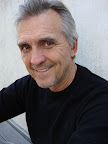
Timur Kocak
ASC Set Designer and Technical Director

The world of a play only begins to take form in the words.  In order for an audience to be drawn in, to suspend disbelief and accept that what is on stage is worth being part of, the creative team must construct a context for the dialogue, a place where characters can come to life.  While the actors and the director will give life to the action, the action must be situated in a physical and atmospheric location that makes sense for that play and the director's vision of it, and it is the set designer who must create the first part of that locale.

For the ASC, the set design relies on Timur Kocak's sense of magic, which, he says, come from a kind of creative flying by the seat of his pants.  "The sets I'm happiest with depend as much on improvisation as any guiding principle," he says.  "I try to create sets that are flexible and, when necessary, invisible."  He aims to have the scenery show off the costumes and keep the audience's attention on the action as it unfolds rather than on his set. 

Many a designer will spend much time discussing with a director what the concept of the play will be, but Colette Rice, the Play Master at ASC, prefers to play to the text rather than to a concept, and the process is a bit different in her collaborations with Kocak, with whom she has been collaborating since 2000. 
Kocak''s last sketch of design and floor painting for Merchant of Venice (2008)


"For example, in the case of MACBETH (2012)," Kocak says; "Colette knew she wanted a stage in traverse, i.e., with the audience on opposing sides; she wanted a bowl of blood and a bowl of water at either end.  It was up to me to come up with set pieces that could create the desired settings: interior, exterior, castle or heath."  If we were outside, the minimal set had to clarify that, and when we were indoors, the set had to bring the audience into the castle.  According to Kocak, to create that effect, he required that floor be painted in colors and patterns that could let the audience imagine a muddy road or the great hall of a medieval castle, and then he worked with Lighting Designer Paul Hudson to get the most out of the effect.  

"All the paint colors and finishes that I use of course depend on lighting for their effect."  In true theatrical tradition, despite coordinated efforts begun well before the rehearsal process began, last-minute adjustments were necessary on Kocak's part.  When lights were fixed, it was clear that he would have to darken the floor and plinths a few degrees. . . "which I achieved with the application of a glaze."

Finding the appropriate set pieces was a challenge for Macbeth because of the director's specificity, but, with perseverance, the set designer triumphed. "It took much searching up and down the Bowery to find large bowls for the blood and water, glass in appearance, but sturdy and resilient.  For the plinths on which the huge bowls rested, I tried to create a faux finish to match photos of the Stone of Scone, which rests below the coronation thrown in Westminster Abbey but comes from the historical seat of Scottish kings, as mentioned in the play's last scene."
Michael Basile as Macbeth, with the Blood Bowl

One of the things Timur Kocak appreciates about working in the West Side Theater is that his sets cannot achieve their desired effect without the engagement of his audience's imagination and their complete submission to the conceit he presents.  He explains, "Settings must be suggested rather than presented in a small space like ours." And, given the vicissitudes of the pursuit of artistic excellence in the economic climate of today, budgets are necessarily small, so the set designer is forced to be more creative.  "I believe," he asserts,"that it is very important not to violate the world of a play.  That is to say that nothing must look, sound or even smell out of place.  If an actor steps onto a platform that is shaped as and painted to look like a tree stump, for instance, it must not sound hollow like a wooden box.  Nor should the smell of cleaner or fresh latex paint intrude on the notion that we are watching say, the French nobility carouse in their camp, the night before the battle of Agincourt."  

"In telling stories," he says, "details are important."   The minutia can make or break an audience's allegiance to the imagery of the scene.  "Small things like zippers and other often misplaced technology, the wrong car (I am from Detroit after all) and even casual contemporary phrases like "you guys" or "...I'm just sayin'... " in a period script can bounce me right out of an otherwise compelling story.  I especially appreciate the show Mad Men for its attention to detail.  I find myself searching every corner of the screen for something from my grandparents' house or wardrobe."  

Mad Men notwithstanding, Kocak believes that large set and costume budgets do not necessarily protect a production from huge mistakes.  The annals of theater and film are rife with those, and Timur Kocak is keeping track.

"My wife has forbidden me from starting my own 'Stage and Screen Historic Anomaly Blog' lest I ruffle the wrong feathers - or just appear silly." 

No theater (or film) director would think him silly. . . continuity matters!

Friday, February 22, 2008

Friday, February 15, 2008

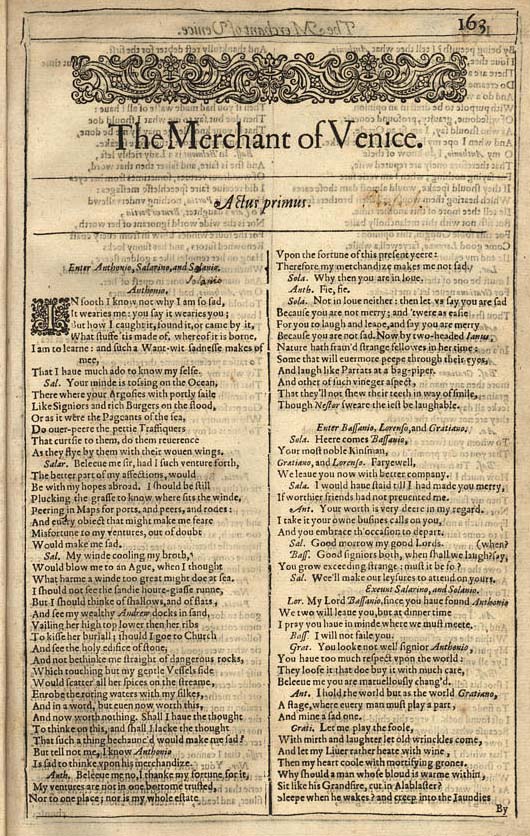
Working with the Original Folio and Quarto Texts


Some words below from Paul Sugarman on ASC's text process, and particularly the Folio and Quarto texts we have been using on Merchant of Venice. Paul has been an ASC actor for several seasons now, and is Salanio in Merchant. He is also the company's resident text expert, which is saying something, considering the general level of Shakespeare nerdiness and self-dramaturgy at ASC! Paul was an editor of the immensely useful Applause edition of the First Folio, and he publishes his own pocket editions of original texts under his Raw Shakespeare imprint.

One of the things that I find most exciting about the Actors Shakespeare Company is that we work with the original published texts of the First Folio and Quartos to get closer to Shakespeare’s original intent. The First Folio was the first collection of Shakespeare’s plays published in 1623, seven years after his death. It included 36 plays, 18 of which had never been published. The book was edited by members of Shakespeare’s acting company and it is believed that the theatre companies prompt scripts were used as a reference, since the stage directions are often quite specific about what needs to be done. The Quartos were texts of individual plays. Most people are probably unaware of how much the modern texts of Shakespeare have been cleaned up and edited to make Shakespeare into a neat literary package. The First Folio and Quarto texts are much messier but with many clues for actors.

Recently there has been a lot of interest in looking at the clues for actors in these early texts, thanks largely to the work of Patrick Tucker who wrote “Secrets of Acting Shakespeare” and Neil Freeman who has compiled “The First Folio of Shakespeare in Modern Type.” The spelling in these original texts is often quite bizarre as you have to keep in mind that this was more than a century before the first English dictionaries, many times these spellings suggest how the words sound. There are also clues for the actors in punctuation and capitalization. Since there was precious little time for rehearsal in Shakespeare’s time (as they could often put on 10 different shows in a 2 week period) there needed to be clues for the actors to pick up their parts quickly. Capitalizing a word in the middle of a line can be a suggestion that the word should be emphasized. A colon can be an indication of a change of approach or a physical move.

Actors Shakespeare Company uses Patrick Tucker’s Folio “kits” which include a master script and cue-scripts, or sides, for the actors, which contain only the character’s lines and their cues, as well as cues for exiting or entering. In Shakespeare’s time that would be all the actor would get, because of the amount of work involved in copying the script and because of the fears of the script being stolen and published in a pirate edition. Working with these “cue scripts” gives us a chance to use some “original practices” by attaching them onto dowels these sides become “rolls”.

Paul Sugarman, in a less scholarly mode


The benefit for an actor of just having your own “roll” is that you only have your own lines and cues to focus on and to have them make sense. It forces the actors to listen for their cues. Being open to the clues in the original text often solves many problems for the actor. Almost all the actors who work with the original text find that these clues often help. Working on these plays in this way it becomes clear that they were written to be performed and were made by the consummate man of the theatre, William Shakespeare.


The Merchant of Venice was popular in Shakespeare’s lifetime and was published several times in “Quarto” form. This gives us and added text to reference along with the First Folio. Many Shakespearean scholars believe that the First Quarto of Merchant is the closest to Shakespeare’s original writing and a better text than the First Folio. Most of the play is the same but there are some key differences. For our production we have started with the First Folio but all the actors were given copies of the First Quarto so that they could refer to it and update their texts if desired.

There will be an Actors Shakespeare Company Quarto published of our performance text of Merchant of Venice with endnotes indicated the textual choices made.

Thursday, January 31, 2008

Merchant Rehearsals Officially Begin

Monday Night was the first full rehearsal for ASC's The Merchant of Venice. ASC first rehearsals are a bit different than many other companies', and come from our history with Unrehearsed Shakespeare. After weeks of private study, as well as one-on-one and small group coaching, the whole cast meets and does the entire play. On their feet. With no rehearsal or set blocking. The result is sometimes messy somtimes sublime, but never boring.

A few pictures of the event from our own "Jessica", Beth Ann Leone:


Justin Gibbs (Bassanio) and Elizabeth Belonzi (Portia)


Jonathan Hopkins (Lorenzo)


Jessica Weiss (Nerissa) and Michael Hajek (Stephano) sing

Tuesday, January 22, 2008

First Look at the Merchant Set

Our talented set designer for The Merchant of Venice, Timur Kocak (also our Salerio!) has shared his latest sketch for the design of the set and floor painting. As usual, it's a lovely thing:


Monday, January 14, 2008

Shylock Speaks


A few thoughts from Peter Galman on his preparation for the role of Shylock in ASC's upcoming production of The Merchant of Venice, opening February 21st:


Shylock in the Merchant of Venice is the voice of oppressed, the trod upon, the rejected, the categorized, the object of scorn that all striving humankind can relate to. Somewhere deep inside us comes a voice that cries out in defense of ourselves when victimized by hatred or even when slighted for one more preferred. It comes from the same place in us that wants a second chance, for the tables to be turned, for a second opinion, for an apology, for vindication. Shylock is presented with such an opportunity, and we see him with it right at the beginning, at the introduction of his character in the play. He senses the rich opportunity of that moment and revels in it. It's what attracted me to him in the first place. This voice compels hearing and demands attention.

"Like my fellow Jews, I may be confined to a ghetto and relegated to the un-Christian business of moneylending, and my words are steeped in deep resentment of my plight, but my spirit yearns to walk the earth as one of God's creatures, in communion with my fellow human beings."

What I am discovering as I go deeper into the development of character is my dual nature. Shakespeare may not have had much experience with Jewish idiosyncrasies, but in the very first scene he hits upon one of the most typical: that of saying one thing but meaning something else! This strikes to the heart of the Jewish stereotype. After I vent to the offer of Antonio all the bilious reasons why I would reject a transaction with the Christian, I do an about face and confide I would be friends and have Antonio's love. That's just the start of exposition to my dual nature. I am torn by a passion, by a conviction that compels me to "use or be used". I have a choice all the way down to the lines at the end and I think if I stay with that dynamic throughout it will make for a compelling characterization.

I am now reading of Shylocks played in past productions, and it amazes me how each, whether it be Edmund Kean, or Sir Tree, or Sir Henry Irving, or Jacob Adler of the great Yiddish Theater in the early 20th Century, becomes a statement of the way to play him as to appeal to the audience of their respective theatres. Irving was all dignity in the face of indecency. Adler edited the play so that he was on stage half the time, and was patriarchal, biblical, a tower of strength, patience amidst suffering. A response to the opinion of some that the play is anti-semitic? Perhaps, but Shakespeare's Jew is loaded with humanity and needs no revision to be given "size". Others may make the argument that Shylock's actions are not true to the Jewish identity, but Shakespeare is not writing to an ideal, but to the idea that we are alike and resemble each other in action within a given circumstance -- "to the time and pressure", one of his great themes.

Friday, January 4, 2008

Justice and Mercy

Some thoughts from Colette Rice, ASC's Artstic Director and Play Master of The Merchant of Venice:

I’m well into individual actor coaching for Merchant. What a joy to work on this play! I honestly had no idea how much I would come to love it. It has always perplexed me. So many productions seem to miss the mark. Yet, I haven’t ever felt certain about what that mark is, exactly.

Working with the actors on individual roles has helped to raise many questions. What does The Jew represent in the play and what does The Christian stand for? Why is it that so many of the characters make less than honorable choices? Is there a “good guy?” How does the plot of the three caskets fit with the Antonio/Shylock plot? Oh, there are so many questions… Today I’ll share a few initial impressions based on our coaching to date.

Shylock may represent the letter of the law in Venice: that within us which is inflexible, rigid, intractable, myopic, greedy, and that which feels it must be “right” at all costs. If we are to realize our potential and unlock our higher natures from the lead caskets in which they are all hidden, these parts of ourselves must be either transformed or rooted out. Shylock has a lot of very good reasons for being how he is and Shakespeare spells those reasons out. Yet, in the end he must be changed, or all is lost.

Shakespeare does an interesting thing in this play. He gives us an antagonist in Shylock about whom an Elizabethan audience would have had very strong and specific judgments. Marlowe’s The Jew of Malta had been exceedingly popular for several years, and depicted a Jew who was merciless, cruel, vicious and miserly – and who gets his comeuppance at the end of the play. The Elizabethans were generally very xenophobic people, regarding strangers of all sorts as suspicious and dangerous. Shakespeare’s audience would “know” Shylock before he even began to speak, and he is somewhat true to form. He tells us that he hates Antonio because he is a Christian and because he lends money as a charity and not a business. He would have been a very easy character for the audience to peg: The Villain – The Other who is not like me.

But, as he often does, Shakespeare adds a twist. He gives us this villain and antagonist, and then has him turn around and accuse us, along with all of the Christian characters, of being exactly like him. I don’t think that Shylock’s most famous speech is so much a plea for understanding as it is an accusation and bitter pill of truth: we are all Shylock.

Certainly the Christian characters in the play, with whose ambitions we seem to be meant to sympathize, are hardly without human frailties. Shakespeare’s Venice is a land famous for its laws and the laws are followed to the letter. Mercy doesn’t seem to be in great abundance, though there is a great deal of hubris and blame. The Venetians of the play seem to live beyond their means and to judge anyone who is not exactly like them. They are hardly living from any ideals of Christianity, despite their protestations of their faith. And then Shylock holds Hamlet’s famous mirror up to their natures – and ours. He tells us to take a look at what made him the way he is. Take a look inside ourselves.

And what is needed in this world of judgment, cruelty, avarice and spite? Divine intervention. Portia serves as a sort of Deus ex machina, descending from Belmont (“beautiful mountain”) to Venice and entering the court disguised as a man to transform the events and characters of the play. She introduces Mercy into this world of fierce justice, first challenging Shylock and then Antonio to find that divinity within that allows us to bestow mercy. Her disguise is necessary in order to enter the court at all – as a woman, she has no place there. Yet it is, in part, her womanly nature and understanding that is needed in the moment. Her heart and her mind are both essential in solving the problem of the bond.

There is so much more to discuss. The play is a bottomless well of wisdom and opportunity to learn about ourselves. We’ll be posting more observations as we delve deeper into coaching and rehearsal. We look forward to seeing you at our opening in February.

-Colette Rice
Producing Artistic Director
Play Master, The Merchant of Venice

Monday, December 17, 2007

The Merchant of Venice Cast List

Meet the Cast of ASC's The Merchant of Venice:


Peter Galman*- Shylock, a rich Jew


Terence MacSweeny - Antonio, a merchant of Venice


Elizabeth Belonzi - Portia, a rich heiress


Justin Gibbs* - Bassanio, Antonio's friend, suitor likewise to Portia

Colin Ryan* - Gratiano, friend to Antonio and Bassiano


Jessica Weiss - Nerissa, Portia's maid-in-waiting


Jonathan Hopkins - Lorenzo, in love with Jessica

Beth Ann Leone* - Jessica, daughter to Shylock


Craig Colfelt - Lancelot Gobbo, the clown, servant to Shylock

Patrick McCarthy* - The Duke of Venice
& Old Gobbo, father to Launcelot

Timur Kocak* - Salerio, friend to Antonio and Bassiano

Paul Sugarman - Solanio, friend to Antonio and Bassiano


Michael Hajek* - Tubal, a Jew, friend to Shylock
& Stephano, servant to Portia


Jordan Meadows* - Prince of Aragon, suitor to Portia


James Rana* - Prince of Morocco, suitor to Portia


*Denotes members of Actors' Equity Association (AEA), The Union of Professional Actors and Stage Managers in the United States.


Tuesday, December 11, 2007

"Bid your friends welcome, show a merry cheer"

Welcome to the new Actors Shakespeare Company blog! ASC is a classical theatre company located in Jersey City, NJ. We are launching this blog to keep you informed of the news and developments with our upcoming productions and events.

Coming next: The Merchant of Venice, playing at the West Side Theater, located on the campus of New Jersey City University, February 21st to March 9th 2008. Tickets are available now at TheatreMania.

More information on Merchant and ASC are always available at our Official Website.

In the coming months, we’ll be chronicling the Merchant creative process here, with previews of costume and set designs; interviews with actors, musicians and designers; and discussions with Artistic Director Colette Rice on ASC’s approach to one of Shakespeare’s most controversial and thought-provoking plays.

So, keep checking back for more news and information!