
One of the best things about ASC's The Play's the Thing New Work series is working with a playwright who isn't dead. As much as we all love Shakespeare, we do often wish we could sit down and pick his brain on the motivations, detail and origins of his works.
So, we did just that with Sean Michael Welch, author of the latest new play in the series, Pompey :
My final performance at the University of Michigan-Flint was in the role of Pompey in Measure for Measure. Pompey is designated as the clown character in the work, but I took a different approach with him, portraying him as a more manipulative and seductive person. Now, in the final act, I had no speaking lines, but was on the stage as an observer. As I sat there, night after night, watching the action unfold, I found the whole end to be deeply unsatisfying. As an actor I understood the metaphor of God's justice, but as a character living in this world, my concern was with the reality before me.And that became the inspiration for the piece.
I has started writing Pompey in 2000, before I moved to New York. I turned out three pages, and then realized I didn't know what I was going for. The concepts were not solidified in my mind, so I left it alone. In 2005, having lived in New York for four years, and seeing more and more ridiculousness in politics, I found that I finally had an angle to work with and a solid concept to work from.
So, Pompey is my voice against the manipulations of powerful people and the use of wealth and influence to escape justice. Not God's justice, but a justice that was meant to incorporate everyone on a level playing field, which is what the American legal system promises to do. And who better to lead us through this exploration than a criminal?
The reading of Pompey is May 14th at 7:30PM at the West Side Theater, 285 West Side Avenue, Jersey City, NJ.
You can read more about ASC here, and more about Sean Michael Welch here.
Showing posts with label From the Artists. Show all posts
Showing posts with label From the Artists. Show all posts
Monday, May 12, 2008


Friday, February 15, 2008
Working with the Original Folio and Quarto Texts
Some words below from Paul Sugarman on ASC's text process, and particularly the Folio and Quarto texts we have been using on Merchant of Venice. Paul has been an ASC actor for several seasons now, and is Salanio in Merchant. He is also the company's resident text expert, which is saying something, considering the general level of Shakespeare nerdiness and self-dramaturgy at ASC! Paul was an editor of the immensely useful Applause edition of the First Folio, and he publishes his own pocket editions of original texts under his Raw Shakespeare imprint.
One of the things that I find most exciting about the Actors Shakespeare Company is that we work with the original published texts of the First Folio and Quartos to get closer to Shakespeare’s original intent. The First Folio was the first collection of Shakespeare’s plays published in 1623, seven years after his death. It included 36 plays, 18 of which had never been published. The book was edited by members of Shakespeare’s acting company and it is believed that the theatre companies prompt scripts were used as a reference, since the stage directions are often quite specific about what needs to be done. The Quartos were texts of individual plays. Most people are probably unaware of how much the modern texts of Shakespeare have been cleaned up and edited to make Shakespeare into a neat literary package. The First Folio and Quarto texts are much messier but with many clues for actors.
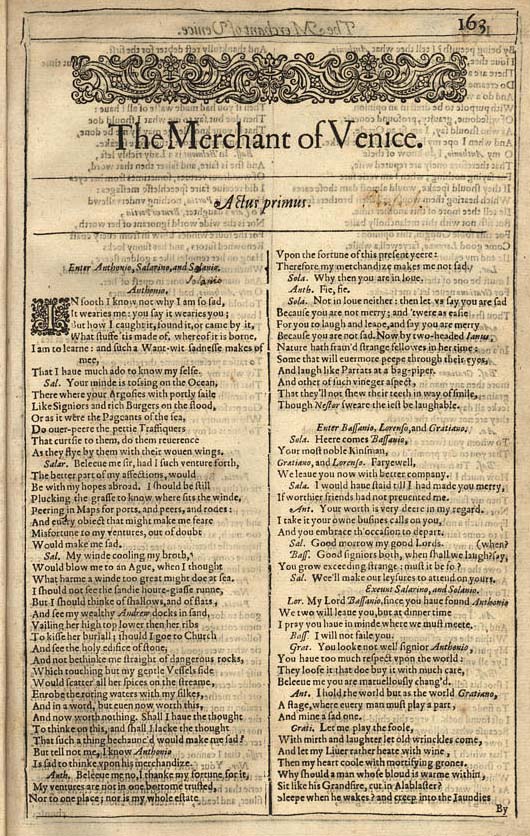
Recently there has been a lot of interest in looking at the clues for actors in these early texts, thanks largely to the work of Patrick Tucker who wrote “Secrets of Acting Shakespeare” and Neil Freeman who has compiled “The First Folio of Shakespeare in Modern Type.” The spelling in these original texts is often quite bizarre as you have to keep in mind that this was more than a century before the first English dictionaries, many times these spellings suggest how the words sound. There are also clues for the actors in punctuation and capitalization. Since there was precious little time for rehearsal in Shakespeare’s time (as they could often put on 10 different shows in a 2 week period) there needed to be clues for the actors to pick up their parts quickly. Capitalizing a word in the middle of a line can be a suggestion that the word should be emphasized. A colon can be an indication of a change of approach or a physical move.
Actors Shakespeare Company uses Patrick Tucker’s Folio “kits” which include a master script and cue-scripts, or sides, for the actors, which contain only the character’s lines and their cues, as well as cues for exiting or entering. In Shakespeare’s time that would be all the actor would get, because of the amount of work involved in copying the script and because of the fears of the script being stolen and published in a pirate edition. Working with these “cue scripts” gives us a chance to use some “original practices” by attaching them onto dowels these sides become “rolls”.

Paul Sugarman, in a less scholarly mode
The benefit for an actor of just having your own “roll” is that you only have your own lines and cues to focus on and to have them make sense. It forces the actors to listen for their cues. Being open to the clues in the original text often solves many problems for the actor. Almost all the actors who work with the original text find that these clues often help. Working on these plays in this way it becomes clear that they were written to be performed and were made by the consummate man of the theatre, William Shakespeare.
The Merchant of Venice was popular in Shakespeare’s lifetime and was published several times in “Quarto” form. This gives us and added text to reference along with the First Folio. Many Shakespearean scholars believe that the First Quarto of Merchant is the closest to Shakespeare’s original writing and a better text than the First Folio. Most of the play is the same but there are some key differences. For our production we have started with the First Folio but all the actors were given copies of the First Quarto so that they could refer to it and update their texts if desired.
There will be an Actors Shakespeare Company Quarto published of our performance text of Merchant of Venice with endnotes indicated the textual choices made.
Monday, January 14, 2008
Shylock Speaks

A few thoughts from Peter Galman on his preparation for the role of Shylock in ASC's upcoming production of The Merchant of Venice, opening February 21st:
Shylock in the Merchant of Venice is the voice of oppressed, the trod upon, the rejected, the categorized, the object of scorn that all striving humankind can relate to. Somewhere deep inside us comes a voice that cries out in defense of ourselves when victimized by hatred or even when slighted for one more preferred. It comes from the same place in us that wants a second chance, for the tables to be turned, for a second opinion, for an apology, for vindication. Shylock is presented with such an opportunity, and we see him with it right at the beginning, at the introduction of his character in the play. He senses the rich opportunity of that moment and revels in it. It's what attracted me to him in the first place. This voice compels hearing and demands attention.
"Like my fellow Jews, I may be confined to a ghetto and relegated to the un-Christian business of moneylending, and my words are steeped in deep resentment of my plight, but my spirit yearns to walk the earth as one of God's creatures, in communion with my fellow human beings."

What I am discovering as I go deeper into the development of character is my dual nature. Shakespeare may not have had much experience with Jewish idiosyncrasies, but in the very first scene he hits upon one of the most typical: that of saying one thing but meaning something else! This strikes to the heart of the Jewish stereotype. After I vent to the offer of Antonio all the bilious reasons why I would reject a transaction with the Christian, I do an about face and confide I would be friends and have Antonio's love. That's just the start of exposition to my dual nature. I am torn by a passion, by a conviction that compels me to "use or be used". I have a choice all the way down to the lines at the end and I think if I stay with that dynamic throughout it will make for a compelling characterization.
"Like my fellow Jews, I may be confined to a ghetto and relegated to the un-Christian business of moneylending, and my words are steeped in deep resentment of my plight, but my spirit yearns to walk the earth as one of God's creatures, in communion with my fellow human beings."
What I am discovering as I go deeper into the development of character is my dual nature. Shakespeare may not have had much experience with Jewish idiosyncrasies, but in the very first scene he hits upon one of the most typical: that of saying one thing but meaning something else! This strikes to the heart of the Jewish stereotype. After I vent to the offer of Antonio all the bilious reasons why I would reject a transaction with the Christian, I do an about face and confide I would be friends and have Antonio's love. That's just the start of exposition to my dual nature. I am torn by a passion, by a conviction that compels me to "use or be used". I have a choice all the way down to the lines at the end and I think if I stay with that dynamic throughout it will make for a compelling characterization.

I am now reading of Shylocks played in past productions, and it amazes me how each, whether it be Edmund Kean, or Sir Tree, or Sir Henry Irving, or Jacob Adler of the great Yiddish Theater in the early 20th Century, becomes a statement of the way to play him as to appeal to the audience of their respective theatres. Irving was all dignity in the face of indecency. Adler edited the play so that he was on stage half the time, and was patriarchal, biblical, a tower of strength, patience amidst suffering. A response to the opinion of some that the play is anti-semitic? Perhaps, but Shakespeare's Jew is loaded with humanity and needs no revision to be given "size". Others may make the argument that Shylock's actions are not true to the Jewish identity, but Shakespeare is not writing to an ideal, but to the idea that we are alike and resemble each other in action within a given circumstance -- "to the time and pressure", one of his great themes.
Subscribe to:
Posts (Atom)


