Saturday, March 10, 2012
Some Witchly Trivia
Macbeth's witches are so familiar in popular culture that they show up in all kinds of reinterpretations, including children's cartoons.
Yet in most productions, much of what was written for the witches is cut because it is extraneous enough that whole segments can be lopped off without leaving holes in the plot structure. Some experts decry this practice, finding many of Shakespeare's thematic stances in their scenes. But the witches we know are so easily dispatched for a very good reason. . . they are not entirely original to Shakespeare's first folio text.
One monologue that is almost universally cut from American productions of Macbeth is that of the Witch Goddess Hecate. Hecate, and many of the oft-cut pieces of the witches' scenes, were lifted from Thomas Middleton's The Witch, incorporated into Macbeth in 1618, along with some songs from the same play, perhaps as much as ten to twelve years after Shakespeare's play was begotten(1603-7). Some experts believe that Middleton and Shakespeare were collaborators, which would perhaps, in part at least, explain why Middleton's material so easily folds into the play.
The Witch was performed by King's Men, Shakespeare's theatre troupe, as early as 1609 but wasn't published till 1778; it has been said that Shakespeare was a bit jealous of his younger contributor and that he credited himself for Middleton's work and then blocked its publication. But the Bard's envy does not explain why he had to be dead for 162 years before it could see the light of distribution.
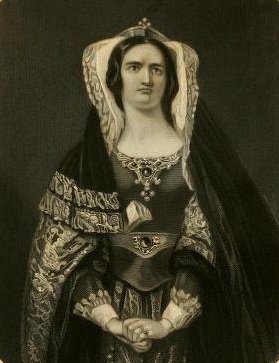
Here's the seldom-heard monologue, where Hecate (usually played by the same actor who portrays Lady Macbeth and believed to have been intended as LM's alterego at the very least) instructs her followers:
HECATE: Have I not reason, beldams as you are,
Saucy and overbold? How did you dare
To trade and traffic with Macbeth
In riddles and affairs of death;
And I, the mistress of your charms,
The close contriver of all harms,
Was never called to bear my part
Or show the glory of our art?
And, which is worse, all you have done
Hath been but for a wayward son,
Spiteful and wrathful, who, as others do,
Loves for his own ends, not for you.
But make amends now: get you gone
And at the pit of Acheron
Meet me i' th' morning. Thither he
Will come to know his destiny.
Your vessels and your spells provide,
Your charms and everything beside.
I am for th' air. This night I'll spend
Unto a dismal and a fatal end.
Great business must be wrought ere noon.
Upon the corner of the moon
There hangs a vap'rous drop profound;
I'll catch it ere it come to ground:
And that, distilled by magic sleights,
Shall raise such artificial sprites
As by the strength of their illusion
Shall draw him on to his confusion.
He shall spurn fate, scorn death, and bear
His hopes 'bove wisdom, grace, and fear:
And you all know security
Is mortals' chiefest enemy.
[Music, and a song.]
Hark! I am called. My little spirit, see,
Sits in a foggy cloud and stays for me.
Friday, March 9, 2012
Who's to Blame Here?
"There was a time," sings Annie Lennox, "that we used to say that behind every great man there had to be a great woman. . . ."
Critics have been arguing back and forth about who's to blame for the evil in Macbeth. Are the witches responsible for reeking havoc on the House of Cawdor? Did Lady Macbeth lead her docile, vulnerable man into temptation and then unleash his furor on the kingdom of Scotland?
Michael Basile, who plays Macbeth in the ASC's production of the play that bears his name, says that the Lady spurs him on until he has actually killed Duncan, and then he takes the wheel of the machine that is careening out of his own control.
It's a question for the ages. See the play, watch Denise Hurd as the Lady, and then weigh in for yourself.
Denise Hurd in rehearsal as Lady Macbeth
Labels:
Annie Lennox,
Aretha Franklin,
ASC,
Denise Hurd,
Lady Macbeth,
Macbeth,
Michael Basile,
wierd sisters,
witches
Thursday, March 8, 2012
Fair foul, foul fair . . . .
Michael Basile in rehearsal as Macbeth
Fair is foul and foul is fair . . . nothing is what it seems. No one says outright what he or she is talking about. The world is turned upside-down, and every person involved in the story is impelled or impeded by an underlying fear, something that belies every word that is said.
This is the world of William Shakespeare's Macbeth, as portrayed in the ASC's production, opening next weekend (16 March) at the West Side Theater. As the title character, Michael Basile is one of seven actors playing all the roles, and he plays Macbeth as a tormented poet paralyzed by his sensibilities but driven to murderous acts by "o'er vaulting ambition." His ideas and imagination imprison the Thane of Cawdor, who is, according to Michael Basile, "stymied, frozen. . . by his deeds and can only break free from his state of inertia by acting violently, savagely."
Says Basile, "The man has a poet's ambition in the body and ambitious mind of a trained killer."
Though most of the other actors will portray multiple roles, Basile will only embody Macbeth. Colette Rice, the production's director, has chosen a ritual circle-storytelling style for her staging to emphasize the centricity of the story. Her rendering of the play is dedicated to the flow of the characters and their impalement on the crux of the story, which, according to Rice, is the about the coexistence of good and evil in everyone.
Rice believes that the main message of Macbeth is that "we must all acknowledge that we are capable of great evil and must recognize what it is in each of us to do our best -and our worst! - and shed a light on our own motives for choosing righteousness or ill.”
Worthy Macbeth, as Michael Basile portrays him, is deeply aware of and inexorably enslaved by his ability to foresee the abiding consequences of his actions. Then he deeply regrets that once he has begun, he can never see the consequences to completion because there is no end. "He wants to make the future the present and then have the present complete, but it never is. He laments that 'it it were done when t'is done' but sees more and more clearly that there is no end. . . . he must kill and kill and kill again." Worst for Macbeth, he sees the omnipresent and universal struggle between good and evil in himself defeating all his goodness. "With each killing, a little more of whatever is noble within him is sacrificed."
Macbeth is consumed by his fury, and he becomes the embodiment of his own destructive passions. He dies violently, entirely unsatisfied.
Interestingly, the play's message, according to Michael Basile, is about inner peace, about telling the truth, being honest. "I want the audience to believe that what they see and hear relates to their lives even though what the characters do -- their actions -- are far more hyperbolic than the actions of most humans."
The Actor Michael Basile
Which is how the actor lives his own life. A teacher of English Literature and Composition at New Jersey City University, Basile has been a member of the ASC since 2007, and he has been on its Board of Directors since 2004. He is proud to be part of the troupe, which he characterizes as a "hard working, generous cast, crew and administration," where it is the material in the play that takes precedence over egos. He would like to see the ASC enabled "to produce more shows and give more of its fine people work."
Though he has loved interacting with Shakespearean text since he saw Zeferelli's Romeo and Juliet as a kid, he has other dreams. Basile is the antithesis of evil, but he is ambitious, especially creatively. If he were not here acting, he might be home with his wife gardening or cooking. He is at work on a collection of poems he has written about his family's life with their autistic son and nurtures a dream of belonging to the Audubon Society, being a birdwatcher; he'd also like to finally learn Spanish and take up the cello, which he had to abandon years ago.
Clearly, one can only do what one can do. Good deeds, too, can be unfinishable.
Sunday, March 4, 2012
And now a word about Lady Macbeth
You don’t have to look too deeply to see the resonances in Shakespeare’s work to current events in whatever time you live. I remember reading Macbeth in high school and thinking that however unsympathetic Lady Macbeth might be, she was a heroine to be admired though feared. I thought how appropriate that she feels the need to invoke the spirits to “Unsex me here” in order to get what she wants, since it is a woman’s sex that keeps her under male control.
Years later, after all the bra burning and the Equal Rights Amendment brouhaha, I saw Macbeth at the RSC, and again I was struck by the Lady’s pertinence. Even in the ‘90’s, glass ceilings and other accouterments of subtle antifeminism were rife.
Today, women’s rights have again become a matter of grave concern for politicians on both sides of the issues, and matters we long since thought resolved are back in the cauldron, coming to a bubbling boil.
Lady Macbeth is relevant because she embodies all that we as a society both admire and fear in women. Lady Macbeth forces Macbeth out of his introspective musings and into the arena of action. She takes control of the situation, and once she does, Macbeth can no longer hide behind his poet’s sensibilities; he must act. His choices are clear. He must collaborate with her or kill her. Because she is so compelling, because she is so forceful, so downright seductive . . . he chooses collaboration, and thus the plot thickens.
It’s the ongoing Human Comedy really. It’s the stuff that everyday human relations as well as world politics are made on.
Saturday, March 3, 2012
The Curse . . . of the Concept
In 2008, Patrick Stewart played the Thane of Cawdor on Broadway, and in advance of the production, Ellen Anthony wrote about the curse of Macbeth for the online Broadway magazine Broadway.tv.
http://www.broadway.tv/broadway-features-reviews/The-Broadway-Curses-Of-Macbeth
Perhaps the pre-show discussion warded off all evil because the show played to packed houses and was a critical success. Many people objected to director's choice of Fascist themes and 1940's totalitarian world, but most found Stewart's portrayal of the ill-fated Thane that shall be king refreshing. As Ben Brantley noted in his review of the play, Stewart found a way to mix the introspection of Hamlet and the murderousness of Richard III.http://theater.nytimes.com/2008/02/15/theater/reviews/15macb.html?pagewanted=all
But the thing about Macbeth is that modern directors like to turn it into a concept play -- something where the idea or the world that Macbeth inhabits is more important than the play itself. Then, when the critics don't like the play, it's easy to blame the curse. But audiences and critics alike come to the theater to see the play. Consider this review of last year's RSC production. http://www.guardian.co.uk/stage/2011/apr/27/macbeth-review
Labels:
Ben Brantley,
Broadway,
Guardian theater review,
king,
Macbeth,
NY Times,
Patrick Stewart,
RSC,
Thane of Cawdor
Friday, March 2, 2012
Something Funny This Way Comes?
One of my favorite Shakespeare spoofs is Seamus Kennedy's Three Minute Hamlet (http://www.youtube.com/watch?v=e31bOXbDyog). Unfortunately, Seamus didn't do the same for Macbeth, but there are a couple cute takes on the play available on YouTube.
So, to get you in the mood for the real thing, take a look at these. . . .
Animaniacs takes on the witches-over-cauldron scene:
http://www.youtube.com/watch?NR=1&feature=endscreen&v=xWQX47spGr0
Tomorrow and tomorrow -- in Spanish, then in Italian
http://www.youtube.com/watch?feature=endscreen&NR=1&v=DJNqSQEqXqI
http://www.youtube.com/watch?v=jM9mF_QQKxY&feature=related
And, in case you like hip-hop, here's the Macbeth rap
http://www.youtube.com/watch?v=E4cMHnWIR9k
Thursday, March 1, 2012
The Curse . . .
Theater folk are terribly superstitious. You can't say Good Luck to players preparing to do a show -- they prefer that you yell MERDRE!, which is like throwing dung, at them or that you suggest they break a leg. Most actors have lucky underwear or something to wear on opening night and run themselves through convoluted rituals before a production.
Of all the superstitions that plague the theater, none is as frightening as that of The Scottish Play. There are those who believe that the very mention of the true title (Macbeth) will cause mayhem to rain down. Variations of the curse abound. Some say you can say the M word except in the theater where it will be played while others say it must never be uttered at all. Some say that there are ways to break the curse while others are resigned to its absolute power. http://www.youtube.com/watch?v=2LKMktAN4hc
Gay Smith, Professor Emeritus of Wesleyan University's Theater Department, and author of the erudite Lady Macbeth in America(http://newsletter.blogs.wesleyan.edu/2010/02/08/smith-publishes-book-on-lady-macbeth-in-america/), theorizes that the curse can be avoided if the production cuts NONE of the witches' speeches. She contends that Lady Macbeth is, in fact, one of the witches, and her sisters must have their due.
The Straight Dope suggests that there are only two superstitions about the curse -- 1.)that it's bad luck to mention the title except during rehearsal or performance, and 2.)that the curse is on the play itself, not on the title, and that any production is doomed.http://www.straightdope.com/columns/read/2267/whats-the-story-on-the-curse-of-em-macbeth-em
The coolest of remedies suggested -- and I've heard it from many sources -- is that Hamlet can save you from the curse. All you need to do is say, as Hamlet does when he first sees his father's Ghost in Act I, Scene IV, "Angels and ministers of grace defend us!"
Of all the superstitions that plague the theater, none is as frightening as that of The Scottish Play. There are those who believe that the very mention of the true title (Macbeth) will cause mayhem to rain down. Variations of the curse abound. Some say you can say the M word except in the theater where it will be played while others say it must never be uttered at all. Some say that there are ways to break the curse while others are resigned to its absolute power. http://www.youtube.com/watch?v=2LKMktAN4hc
Gay Smith, Professor Emeritus of Wesleyan University's Theater Department, and author of the erudite Lady Macbeth in America(http://newsletter.blogs.wesleyan.edu/2010/02/08/smith-publishes-book-on-lady-macbeth-in-america/), theorizes that the curse can be avoided if the production cuts NONE of the witches' speeches. She contends that Lady Macbeth is, in fact, one of the witches, and her sisters must have their due.
The Straight Dope suggests that there are only two superstitions about the curse -- 1.)that it's bad luck to mention the title except during rehearsal or performance, and 2.)that the curse is on the play itself, not on the title, and that any production is doomed.http://www.straightdope.com/columns/read/2267/whats-the-story-on-the-curse-of-em-macbeth-em
The coolest of remedies suggested -- and I've heard it from many sources -- is that Hamlet can save you from the curse. All you need to do is say, as Hamlet does when he first sees his father's Ghost in Act I, Scene IV, "Angels and ministers of grace defend us!"
Subscribe to:
Posts (Atom)


%5D.jpg)
%5D.jpg)